Download
Abstract
Identifying and disentangling sources of predictive uncertainty is essential for trustworthy supervised learning. We argue that widely used second-order methods that disentangle aleatoric and epistemic uncertainty are fundamentally incomplete. First, we show that unaccounted bias contaminates uncertainty estimates by overestimating aleatoric (data-related) uncertainty and underestimating the epistemic (model-related) counterpart, leading to incorrect uncertainty quantification. Second, we demonstrate that existing methods capture only partial contributions to the variance-driven part of epistemic uncertainty; different approaches account for different variance sources, yielding estimates that are incomplete and difficult to interpret. Together, these results highlight that current epistemic uncertainty estimates can only be used in safety-critical and high-stakes decision-making when limitations are fully understood by end users and acknowledged by AI developers.
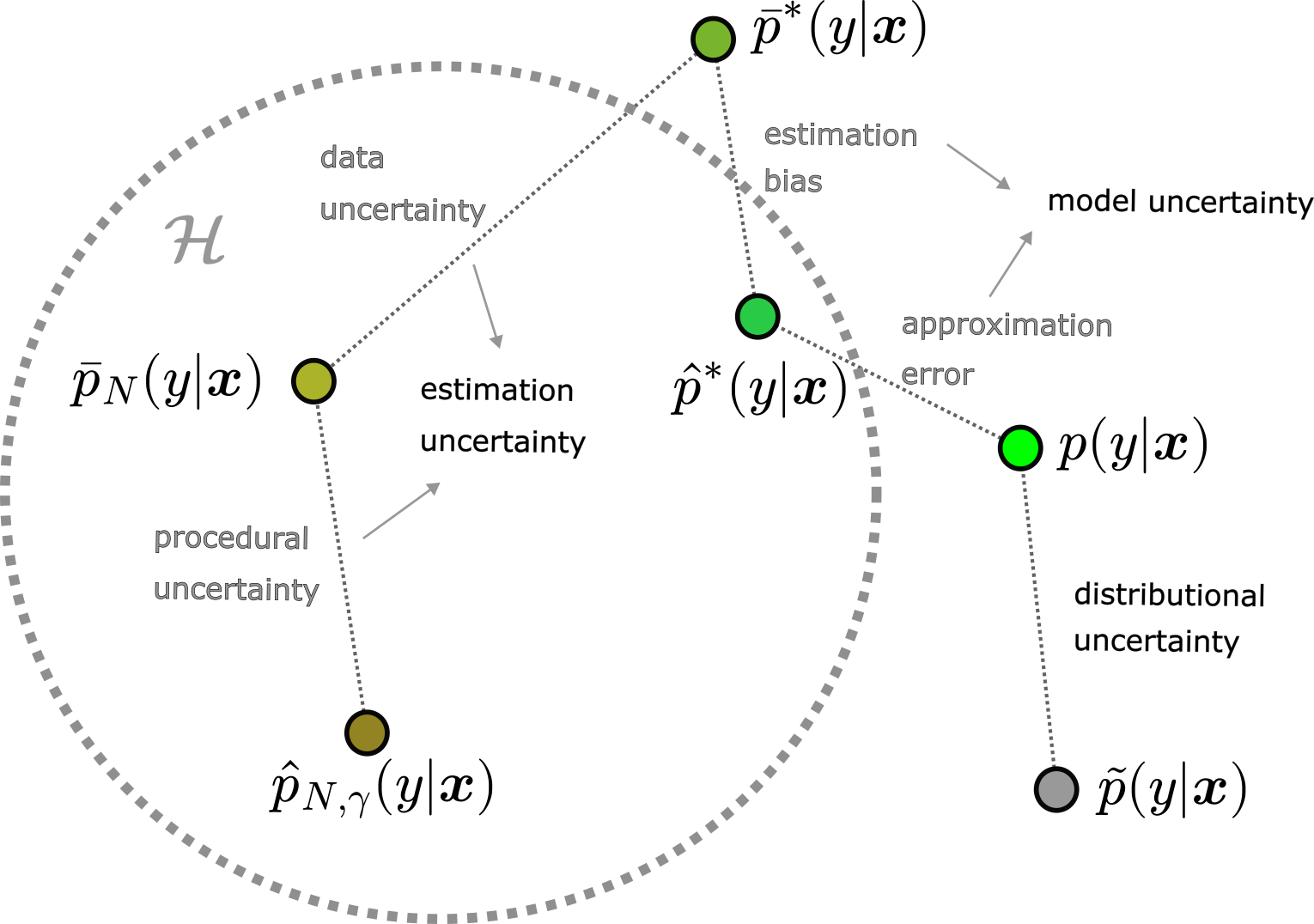
Figure: Sources of epistemic uncertainty in supervised learning
Citation
Sebastián Jiménez, Mira Jürgens, and Willem Waegeman. 2026. “Position: Epistemic uncertainty estimation methods are fundamentally incomplete.” ICML 2026.
@article{jimenez2025machine,
  title={Why machine learning models fail to fully capture epistemic uncertainty},
  author={Jim{\'e}nez, Sebasti{\'a}n and J{\"u}rgens, Mira and Waegeman, Willem},
  journal={arXiv preprint arXiv:2505.23506},
  year={2025}
}